If you're buying a home and you have children, or plan to, the school down the road can matter as much as the number of bedrooms or a south-facing garden. "Is this in the catchment for the school?" is one of the first questions estate agents hear from buyers.
But school catchment areas are often misunderstood. They're not fixed lines on a map. One side of a street can be in the catchment and the other side not. And living in the catchment area doesn't guarantee your child a place. Here's what you need to know before you fall in love with a house.
What is a school catchment area?
A catchment area is the area around a school. If you live inside it, your child usually gets priority for a place when you apply. But not every catchment works in the same way. Each council or school can decide how places are given out. Common types are:
- Mapped catchment or priority areas: a set zone drawn by the council or school.
- Distance only: there's no fixed zone. Places go to the children who live closest.
- Feeder schools: priority for children already at a linked nursery or primary school.
Not every school uses a catchment area, so always check rather than assume.

Does living in the catchment area guarantee a school place?
No. When a school has more applicants than places, it gives out places in the order set by its admission criteria. Living in the catchment moves you up the list, but nothing is guaranteed.
In England, all state-funded schools must give top priority to children who are in care or have been in care (GOV.UK, n.d.a). Children with an education, health and care (EHC) plan that names the school must also be given a place. After that, schools may give priority to children who (GOV.UK, n.d.a):
- live close to the school
- have a brother or sister at the school already
- follow a particular religion (at faith schools)
- pass an entrance exam, such as the 11-plus (at grammar schools)
- go to a feeder nursery or primary school
- are eligible for the pupil premium or service pupil premium
The rules for schools in England are set out in the School Admissions Code. Wales, Scotland and Northern Ireland have their own rules.
Why do catchment areas change each year?
Where a school gives places by distance, there's no permanent boundary. The "catchment" is really the last distance offered: how far away the last child to get a place lived. This changes every year with demand. For example, if lots of brothers and sisters apply one year, there are fewer places left for distance, so the cut-off shrinks. A house that was comfortably in catchment last year could fall just outside it this year.
How distance is measured matters too. Some councils measure in a straight line from the school to your home. Others use the walking route. The same house could get a different answer depending on the method.
What catchment areas mean for your budget
Homes near popular schools are in high demand, so buyers often pay more for them. Before you pay extra for a catchment, check:
- the school's last distance offered for the past few years (your council usually publishes this)
- how the council measures distance
- whether the school has other priorities, such as siblings or faith, that come before distance
- the school's latest Ofsted report
Remember that you'll apply for a school place based on where you live at the time, so timing your move matters. Ask your council about its deadlines and how it treats house moves.

Common catchment myths
"If I'm in the catchment, I'm guaranteed a place." Not true. It raises your chances, but it never guarantees a place.
"I can only apply to my catchment school." Not true. You can apply to schools outside your catchment, and even in a different council area.
"I'll just use a relative's address." Don't. Councils check addresses. A place won with a misleading application can be taken away, even after your child has started at the school.
"Catchments never change." Not true. They can and do change, sometimes every year.
Check school catchment in seconds with Planna
Digging through council websites for every property on your shortlist takes time. Planna's catchment checker covers the whole of the UK. Pop in an address and see which school catchments it falls into. If getting into a certain school is a priority, you can rule properties in or out before you book a viewing.
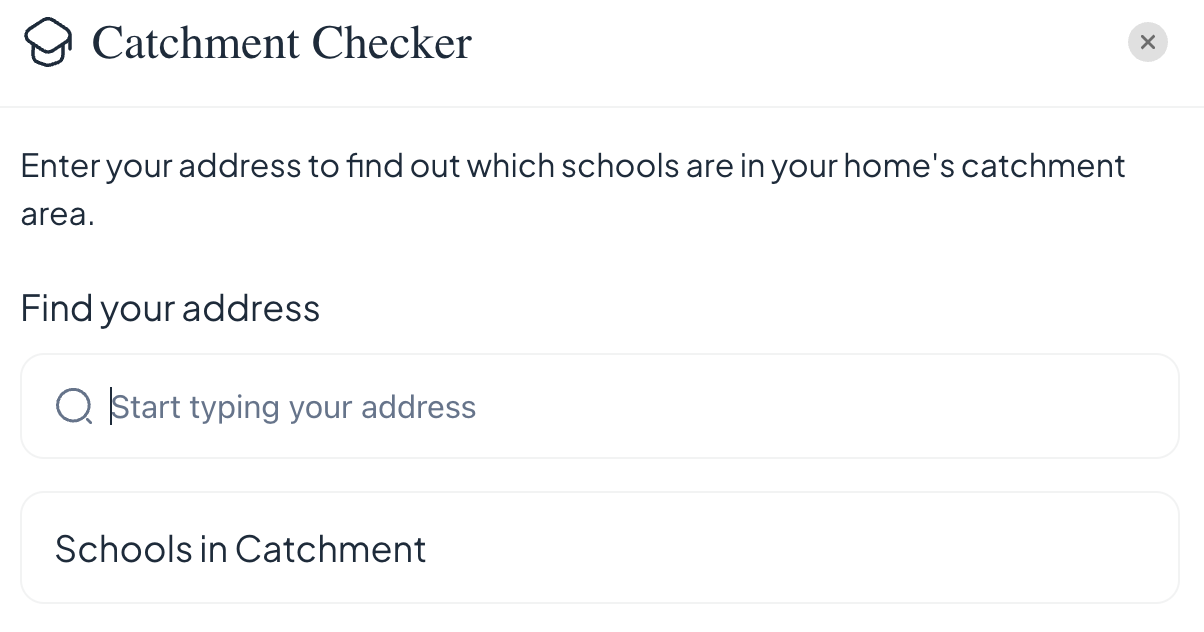
Once you've checked catchment in the Area Guide, you can explore everything else about the area, from cafés nearby to local crime. For a specific property, a Planna Home Report shows you running costs, the EPC rating and maintenance budgets.
What if you don't get the school you wanted?
You can appeal. The admission authority must give you at least 20 school days to appeal from when they send the decision letter. You must appeal against each rejection separately, and you can only appeal once against each one (GOV.UK, n.d.b). You can also ask to go on the school's waiting list.
School catchment areas: quick answers
How do I find out which catchment area a house is in?
Check your local council's website, or use Planna's Area Guide to see the school catchments for any UK address.
How many children get their first-choice school?
In England in 2026, 83.6% of secondary applicants and 92.4% of primary applicants were offered their first choice (Department for Education, 2026).
Can I apply to a school outside my catchment?
Yes. You can apply to any state school, but children in the catchment may get priority.
Do catchment areas change?
Yes. Where places are given by distance, the cut-off can change every year.
Is it worth paying more for a house in a good school catchment?
Only if you've checked the last distance offered and the school's other priorities. A catchment never guarantees a place.
Planning your move around schools? For more help, read our guides to choosing a new neighbourhood and how to search for a property. Whatever your next move, see how Planna can help at every stage of your home journey.
References
Department for Education (2026) Primary and secondary school applications and offers: 2026/27. Available at: https://explore-education-statistics.service.gov.uk/find-statistics/primary-and-secondary-school-applications-and-offers/2026-27 (Accessed: 5 November 2026).
Department for Education (2021) School Admissions Code. Available at: https://www.gov.uk/government/publications/school-admissions-code--2 (Accessed: 5 November 2026).
GOV.UK (n.d.a) School admissions: admissions criteria. Available at: https://www.gov.uk/schools-admissions/admissions-criteria (Accessed: 5 November 2026).
GOV.UK (n.d.b) School admissions: appealing a school's decision. Available at: https://www.gov.uk/schools-admissions/appealing-a-schools-decision (Accessed: 5 November 2026).